

What Does a Branding Agency Actually Do? (And Do You Need One?)

Kaga Bryan
October 16, 2026
6
min read
TL;DR: A branding agency builds the strategic and visual foundation of your business — not just a logo. The good ones start with positioning, audience research, and competitive analysis before touching a single colour swatch. If you're launching, rebranding, or growing fast, a branding agency can be the difference between a brand people trust and one they forget. But you don't always need one, and we'll tell you when you don't.
What does a branding agency actually do?
Here's the short version: a branding agency defines who your business is, what it stands for, and how it shows up in the world — then translates all of that into a system of visuals, words, and guidelines that your team can actually use.
Here's the longer version: most people think branding = logo. It doesn't. A logo is one output of a much larger process. A proper brand identity agency works across strategy, design, and language to create a complete brand system. That system tells your audience what you do, why you're different, and why they should care — before anyone reads a word of your marketing copy.
Quick example: Nike wasn't always Nike. The company started as Blue Ribbon Sports — a name that said nothing about athletic ambition or cultural identity. A branding agency helped them rename, reposition, and build the visual and verbal identity that turned a shoe distributor into one of the most recognised brands on the planet. That's the kind of transformation we're talking about.
According to Lucidpress (now Marq), consistent brand presentation across all platforms can increase revenue by up to 23% (Lucidpress, 2024). That's not because a nice logo makes people buy things. It's because a clear, consistent brand builds recognition and trust over time.
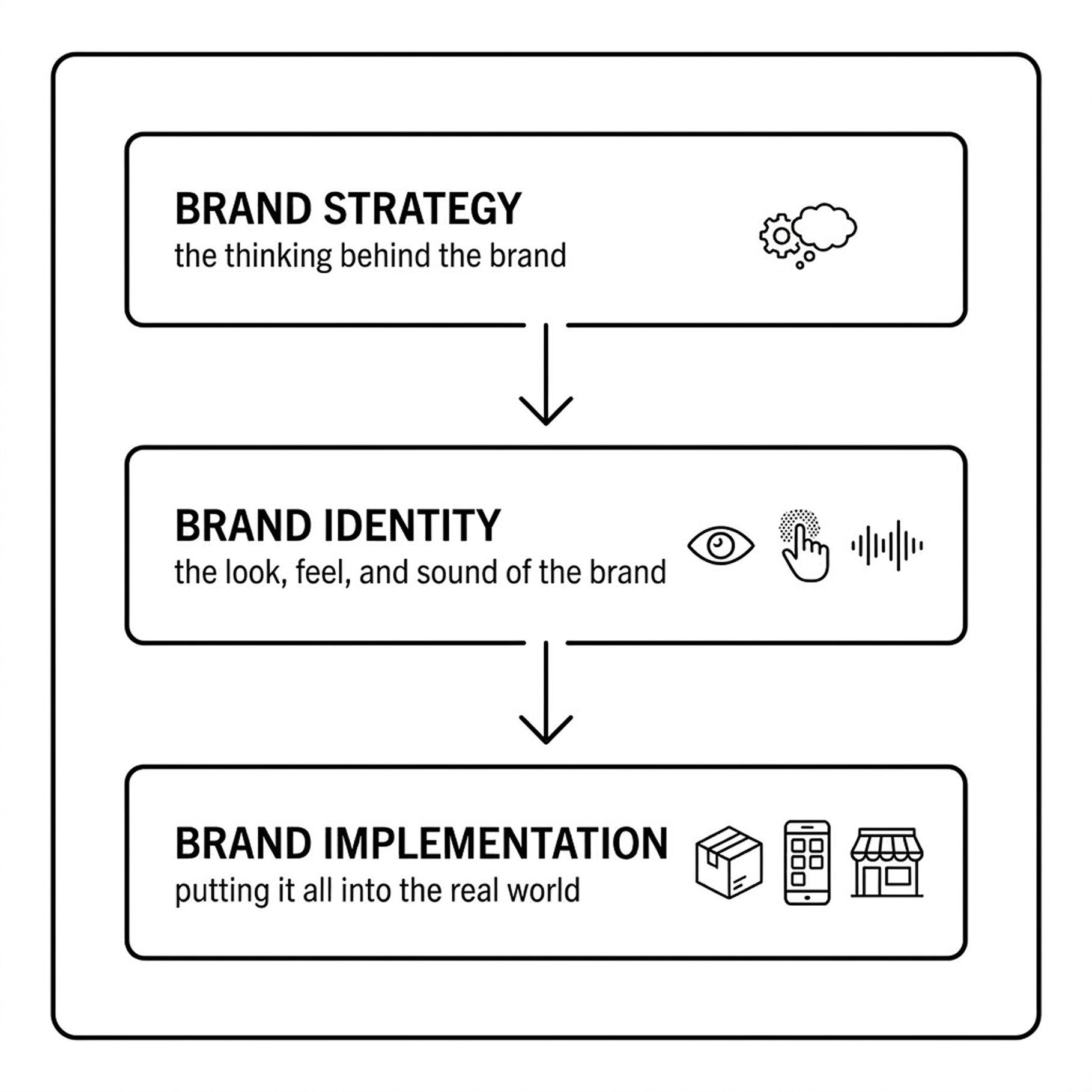
A brand development agency typically handles three big layers of work:
- Brand strategy — the thinking behind the brand
- Brand identity — the look, feel, and sound of the brand
- Brand implementation — putting it all into the real world
If an agency skips straight to the second layer without doing the first, that's a red flag. You'll end up with something that looks nice but doesn't mean anything. We've seen it happen more times than we'd like.
The five core services of a branding agency
Not every brand building agency offers the same scope, but here's what you should expect from a solid one.
1. Brand strategy
This is the foundation. Brand strategy covers your market positioning, target audience, competitive landscape, brand values, and brand personality. It answers the question: what does this brand stand for, and why would anyone choose it over the alternatives?
Expect deliverables like brand positioning statements, audience personas, competitive audits, and a strategic platform that guides every creative decision that follows.
Most good agencies will build out a brand messaging framework as part of strategy. Here's what that typically includes:
- Positioning statement — A concise internal statement that defines who you serve, what you offer, and why you're different. It's not customer-facing copy — it's the strategic anchor everything else hangs off.
- Mission and vision — Your mission is what you do and why. Your vision is where you're headed. Together they give your team (and your audience) a reason to care beyond the product.
- Tagline — The punchy, external-facing line that captures your brand's essence. Think Nike's "Just Do It" or Apple's "Think Different." It should feel inevitable once the strategy is right.
- Brand descriptors — A set of 3–5 words or phrases that define your brand's personality. Are you bold and provocative, or calm and authoritative? These descriptors shape everything from design choices to how your team writes emails.
2. Visual identity
This is what most people picture when they think of branding agency services. It includes your logo (yes, that too), colour palette, typography system, iconography, imagery style, and any other visual elements that make your brand recognisable.
But here's the thing — a good visual identity isn't decorative. Every colour, typeface, and graphic choice should trace back to the strategy. If someone asks "why did you pick that shade of green?" and the answer is "it looked cool," the agency didn't do the work.
Look at Apple's logo evolution. They went from a detailed illustration of Isaac Newton under a tree to the rainbow apple, then to the minimalist monochrome mark we know today. Each change wasn't random — it reflected a shift in brand strategy, from niche computer company to mainstream lifestyle brand. The logo evolved because the positioning evolved first.
3. Verbal identity
Your brand's voice — how it sounds in writing and conversation. This includes tone of voice guidelines, messaging frameworks, taglines, and sometimes brand naming. Verbal identity is the bit that most budget branding agencies skip entirely, and it's often the bit that matters most for how customers experience your brand day-to-day.
4. Brand guidelines
The rulebook. A brand guidelines document (or digital brand hub) tells everyone on your team — and every external designer, writer, or developer — exactly how to use the brand consistently. Without this, you've got a beautiful identity that falls apart the moment someone else touches it.
5. Implementation and rollout
This is where the brand meets the real world. It might mean designing your website, creating templates for social media, building a pitch deck, designing packaging, or producing signage. Not every branding agency handles implementation (some hand off after the guidelines stage), so it's worth asking upfront.
Services comparison: logo designer vs freelancer vs agency
One of the most common questions we hear: do I need a branding agency, or can I just hire a designer? It depends on what you actually need.
| Capability | Logo designer | Branding freelancer | Boutique branding agency | Full service agency |
|---|---|---|---|---|
| Logo design | Yes | Yes | Yes | Yes |
| Brand strategy | No | Sometimes | Yes | Yes |
| Visual identity system | No | Yes | Yes | Yes |
| Verbal identity | No | Rarely | Yes | Yes |
| Brand guidelines | No | Basic | Comprehensive | Comprehensive |
| Brand naming | No | Sometimes | Often | Yes |
| Implementation (web, print, etc.) | No | Limited | Often | Yes |
| Ongoing brand management | No | No | Sometimes | Yes |
| Typical cost (AUD) | $500–$3,000 | $5,000–$15,000 | $15,000–$50,000 | $50,000–$150,000+ |
| Best for | Quick, budget projects | Solopreneurs, small biz | SMBs, startups, scaleups | Enterprise, national brands |
The right choice isn't always the most expensive one. If you're a solo consultant who just needs a sharp logo and basic brand assets, a good freelancer will serve you well. But if you're building a brand that needs to work across multiple touchpoints, communicate a clear market position, and scale with your business — that's where a brand identity agency earns its fee.
Branding agency vs marketing agency vs design agency
This is one of the most common points of confusion we see. People use these terms interchangeably, but they're genuinely different disciplines. Here's how they stack up:
| Capability | Branding agency | Marketing agency | Design agency |
|---|---|---|---|
| Primary focus | Defining who you are and how you show up | Promoting your brand to drive leads and sales | Creating visual and digital experiences |
| Core deliverables | Brand strategy, identity system, guidelines, naming | Campaigns, ads, SEO, content, social media | Websites, apps, graphic design, UX/UI |
| When you need them | Launching, rebranding, or repositioning | You’ve got a brand — now you need customers to find it | You need specific design assets or digital products |
| Strategic depth | Deep — starts with market positioning and audience | Medium — strategy focused on channels and campaigns | Varies — some are strategic, many are execution focused |
| Typical engagement | Project based (6–12 weeks) | Retainer or campaign based (ongoing) | Project based (varies) |
| Think of it as | Building the foundation of the house | Getting people to visit the house | Decorating the rooms |
The short version? A branding agency builds the brand. A marketing agency promotes it. A design agency creates specific things with it. Some agencies blur these lines (and that's fine), but it helps to know which problem you're actually solving before you pick a partner.
When you need a branding agency
There are a handful of situations where working with a branding agency isn't just helpful — it's pretty much necessary.
You're launching a new business or product
Starting from scratch? You've got one chance to enter the market with a clear identity. A brand development agency will help you figure out your positioning before you commit to a visual direction. That strategic foundation saves you from expensive course corrections later.
You're rebranding
Your business has evolved, but your brand hasn't kept up. Maybe your visual identity feels dated, your messaging doesn't reflect what you actually do anymore, or you've outgrown the DIY brand you started with. A rebrand isn't just a logo swap — it's a strategic repositioning exercise, and it's hard to do that objectively from the inside.
Airbnb's 2014 rebrand is a textbook example. They'd grown from a scrappy "air mattress" startup into a global travel platform, but the brand still felt like a tech startup. Working with DesignStudio, they repositioned around the idea of "belonging anywhere," introduced the Belo symbol, and built a visual system that worked in every country they operated in. The brand finally matched the business.
You've just been through a merger or acquisition
Two companies becoming one? That's a branding challenge on every level — from name and visual identity to internal culture and external messaging. This is specialist territory.
You're entering a new market
Expanding into a different industry, demographic, or geography often means your current brand doesn't translate. An agency can help you understand the new audience and adapt your brand accordingly.
You've just raised funding
Post-funding is a common trigger for branding work. You've got traction, you've got capital, and now you need a brand that matches the ambition. Investors notice this stuff too — a polished, well-positioned brand signals operational maturity.
According to a McKinsey report, companies with strong brands consistently outperform the market by 20% (McKinsey, "The Business Value of Design," 2024).
10 signs you need a branding agency
Not sure if it's time? Here's a quick self-assessment. If you're ticking off three or more of these, it's probably worth having a conversation.
- You can't explain what makes you different in one sentence. If your team struggles to articulate your competitive advantage clearly, that's a strategy problem.
- Your website, socials, and pitch deck all look like they're from different companies. Inconsistency is the number one sign your brand needs professional attention.
- You're embarrassed to hand out your business card. If your visual identity doesn't match the quality of your work, it's holding you back.
- You're competing on price because you can't compete on brand. When customers can't see the difference between you and the next option, they default to the cheapest one.
- Your competitors all look the same — and so do you. If your industry has a "sea of sameness" problem and you're swimming in it, branding can pull you out.
- You've outgrown your DIY logo from year one. That Canva logo got you started, and that's fine. But you're not a startup anymore.
- You're about to raise funding or pitch investors. First impressions matter, and sophisticated investors notice when a brand doesn't match the ambition.
- You've merged with another company or acquired one. Two brands becoming one is tricky. Getting it wrong creates confusion internally and externally.
- Your team can't consistently describe what you do. If everyone on your team gives a different elevator pitch, you've got a messaging problem.
- You're expanding into a new market or audience. What worked in one market won't always translate to another. New audience = new brand considerations.
A Nielson study found that 59% of consumers prefer to buy new products from brands they already recognise (Nielsen Global New Product Innovation Survey). If people don't recognise or remember your brand, you're starting every sale from scratch.
When you DON'T need a branding agency
We'd love your business — but honesty matters more. Here are two situations where hiring a branding agency probably isn't the right call.
You just need a logo refresh
If your brand strategy is solid, your positioning is clear, and you just need the visual identity updated, a skilled freelance designer can handle that. You don't need to pay for a full strategic process when the strategy already exists. Save your budget for when it counts.
You have a strong internal brand team
Some companies — especially larger ones — have in-house brand teams that handle strategy, design, and implementation. If your team has the strategic chops and creative skills, you might only need an agency for a specific project (like naming or a brand audit) rather than a full engagement.
What to look for when choosing a branding agency
Not all branding agencies are created equal. Here's what separates the good ones from the logo factories.
A clear, strategic process
Ask the agency to walk you through their process. If it starts with "we'll design a few logo concepts" rather than "we'll start by understanding your market and audience," keep looking. The best branding agencies lead with strategy, not aesthetics.
At UntilNow, our process starts with research and positioning before we open a design tool. That's not because we're slow — it's because design decisions without strategic context are just guesses.
Portfolio with strategic depth
Look beyond the pretty pictures. Does their case study explain why they made specific design decisions? Can you see the thinking behind the visual identity, or just the final output? A strong portfolio tells the story of the problem, the strategic response, and the creative solution.
Chemistry and communication
You're going to spend weeks (sometimes months) working closely with this team. Do they listen? Do they ask good questions? Do they push back when they disagree, or just nod along? The best brand identity agency relationships feel like a partnership, not a transaction.
If you're in Sydney, you can see exactly how we run this process — and the seven specialisms underneath it, from strategy to naming to guidelines — on our branding agency page.
Strategic depth, not just design talent
Plenty of agencies employ brilliant designers. Fewer employ brilliant strategists. The agency you choose should be able to articulate your brand positioning as clearly as they can design your logo. If they can't explain your competitive advantage in a sentence, how are they going to communicate it through design?
How much does a branding agency cost in Australia?
Let's talk money. Branding costs in Australia vary wildly, so here are the realistic ranges as of 2026.
Freelancer: $5,000–$15,000
At this level, you're working with a solo brand designer or strategist. You'll get a logo, basic visual identity, and maybe a simple brand guidelines document. Some freelancers are phenomenal — especially those who've spent years in agencies — but you're limited by the bandwidth and skillset of one person.
Boutique agency: $15,000–$50,000
This is the sweet spot for most SMBs and startups. A boutique branding agency (like UntilNow) will deliver a full brand strategy, visual identity system, verbal identity, and comprehensive guidelines. You're getting a small team with complementary skills — typically a strategist, a designer, and a creative director.
Large agency: $50,000–$150,000+
Enterprise-level branding. You're paying for larger teams, deeper research, more rounds of stakeholder engagement, and often a longer rollout period. This makes sense for national or international brands with complex architecture, multiple sub-brands, or large-scale implementation needs.
One more thing: cost isn't just about the upfront investment. A cheap brand that doesn't work costs more in the long run because you'll redo it within two years. According to Reboot Online, it takes 5 to 7 brand impressions for someone to remember a brand (Reboot Online, 2024). If your brand identity keeps changing because it wasn't built right, you're resetting that counter every time.
FAQ
What's the difference between a branding agency and a marketing agency?
A branding agency builds your brand's identity — the strategy, visuals, voice, and guidelines that define who you are. A marketing agency promotes that brand through advertising, content, social media, and campaigns. Think of branding as building the foundation, and marketing as putting it to work. Some agencies do both, but they're fundamentally different disciplines.
How long does a branding project take?
Most full branding projects take between 6 and 12 weeks from kickoff to final delivery. Smaller projects (like a visual identity refresh) might take 4 to 6 weeks, while complex enterprise rebrands can stretch to 6 months or longer. The timeline depends on scope, decision-making speed on your end, and whether you need implementation included.
Can a branding agency help with naming?
Yes — many branding agencies offer brand naming as part of their services or as a standalone project. Naming involves competitive research, linguistic screening, domain availability checks, and trademark searches. It's a surprisingly intensive process, which is why most agencies charge separately for it.
What should I prepare before hiring a branding agency?
Come with clarity on your business goals, target audience, competitive landscape, and budget range. You don't need all the answers — that's what the agency is for — but having a solid brief speeds things up significantly. Also gather any existing brand assets, past research, and examples of brands you admire (and why).
How do I know if my brand needs a refresh or a full rebrand?
A refresh updates the visuals while keeping the core strategy intact — think modernised logo, updated colour palette, or refined typography. A full rebrand rethinks the positioning, messaging, and identity from the ground up. If your business model, audience, or market has fundamentally changed, you probably need a rebrand. If the strategy still holds but the look feels dated, a refresh will do. Talk to us if you're not sure which one you need.
Need help figuring out whether your brand needs strategic work, a visual refresh, or a complete overhaul? Get in touch with UntilNow — we'll give you an honest assessment, even if the answer is "you don't need us right now."
